

The Garden Chronicles: What Returns
On Friendship, Arugula, and the Things That Refuse to Stay Gone.

The season begins with water.
Not officially. The calendar declared spring weeks earlier. But spring in southern Ontario has become increasingly strange — cold hanging on too long, then suddenly collapsing into heat. This year, we seemed to leap directly from chilly gray days into summer temperatures.
So for me, the garden season truly begins when I fill the water.
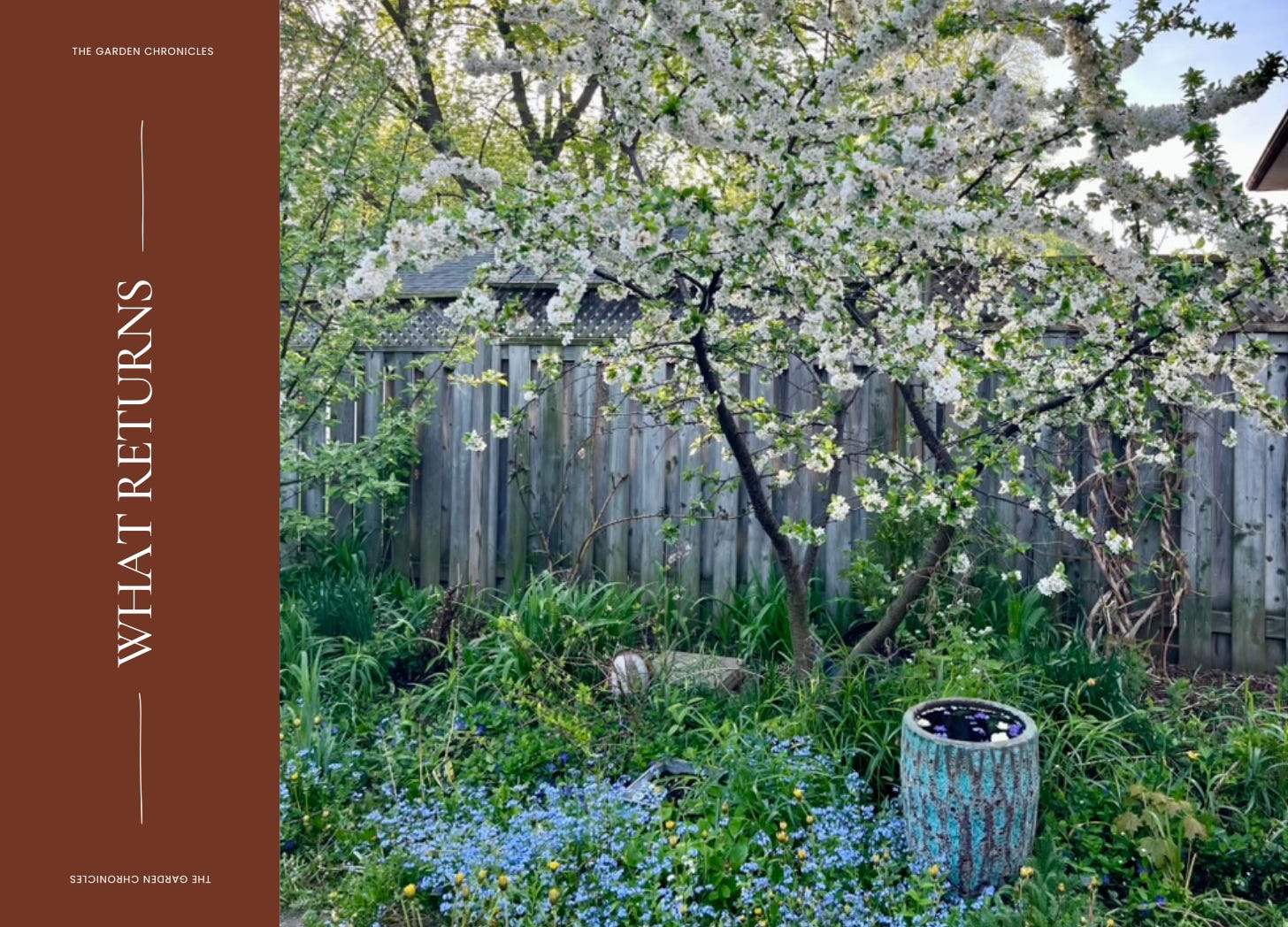
The stock tank pond goes first. Then the pot fountain in the Paradise Garden. Then the ceramic pot filled with floating flowers under my Evans sour cherry. Water changes everything. The birds return immediately. The air softens. The garden stops looking dormant and starts feeling inhabited again.


And this year, almost overnight, the boulevard garden began growing by leaps and bounds. Every morning something had stretched taller or unfurled further. We moved directly from late winter to summer, skipping spring.
Which, judging from Europe right now, is becoming a more common experience.
As many of you know, I’m a native Texan living outside Toronto. Usually my southern knowledge is entirely unhelpful here. Texans are not particularly equipped for six months of Canadian winter darkness. But suddenly, I’m useful.
So here is my inherited southern wisdom, passed through Texas grandmothers and Chicago heat-wave summers: open the house while the air is still cool. Create cross breezes with windows opposite each other. Tilt blinds upward to block direct sun while still allowing airflow. Ceiling fans matter enormously and should rotate counterclockwise in summer. Box fans in windows can help pull cooler air inward or push hot air out. My grandmother used to hang damp sheets in front of fans. It truly helps.
And perhaps most importantly: know where the cool air is. Libraries. Movie theaters. Cafés. There is no moral virtue in suffering through dangerous heat.
Also: iced tea exists for a reason.
Or, in my case, hibiscus tea.
For years, I’ve made a version of jamaica — the deep ruby hibiscus drink common across Mexico and parts of Latin America. During my pregnancies, when I was avoiding both sugar and caffeine, I started making it with hibiscus, rose hips, and true cinnamon, somewhere between herbal tea and agua fresca. Recently I made a batch of concentrate in the Instant Pot and threw in a spent orange for the flavor of the peel. It’s unsweetened, ice cold, and perfect in the heat.


Not Everything Returned
This year has been a challenging gardening season in ways both ordinary and strange. Some of the damage from last fall’s drought is only becoming fully visible now. Several roses died back hard over winter. My Venus dogwood — usually spectacular — produced perhaps seven blooms total. The butterfly magnolia offered only a handful.
So this spring, assuming some roses were truly dead, I bought replacements.
And naturally, several of the “dead” roses have now resprouted. From the rootstock or above the graft? I’m not sure, and gardening has a way of humbling certainty.
In March, everything looks dead here. By May, some things still look dead. But underground, life is often busy making different plans.
Not everything returned, though.
Last year I couldn’t find my rhubarb, but I wasn’t yet willing to give it up for lost. This year, I finally did.
Dave loved rhubarb. We had the old green kind, and I used to make what we affectionately called “snot jam” from it — thick green rhubarb preserves that looked objectively terrible and tasted wonderful. Like asparagus, rhubarb is really a crop for people who have help eating it. Too much abundance for one person unless you preserve aggressively.
If I replace it, I think I’ll plant the pink kind this time, not recreating exactly what was there before, just continuing differently.


And then there’s the arugula.
The summer that Dave died, I discovered that while my carefully planted seedlings struggled, self-seeded wild arugula had quietly taken over an entire bed. I remember standing there laughing in relief. The garden had fed us anyway.
This year, once again, the self-seeded arugula is thriving.
Technically it’s not perennial here. It simply reseeds itself enthusiastically enough to feel perennial. Every year it decides where it wants to live, and every year I mostly surrender to its opinion.
There’s something reassuring about plants that return without being asked.
Asparagus. Self-seeded arugula. Fruit brambles and shrubs planted by previous owners decades ago, and by us far more recently. Perennials pushing upward after winters that looked too harsh. Not flourishing, exactly. Not this year at least. But surviving. Continuing.
Puttering
Which brings me to friendship.
A close friend was recently visiting for work again. He came in from a frustrating meeting and, instead of stewing indoors, went outside and started gardening.
Not light gardening, either.
He weeded aggressively, lifted flagstones to weed underneath them, moved large shrubs and plants I couldn’t have shifted alone. The kind of heavy, invisible maintenance work that changes how a garden ages over years.
I wasn’t even outside while he was doing it. The heat and sun were too much for me and my sun allergy. Instead I kept looking out the window in disbelief that someone was voluntarily working that hard in the afternoon heat.
My mother understood it immediately. She laughed when I told her and reminded me how Dave used to come home and “putter” in the garden for fifteen or twenty minutes after work.
I never really considered his “puttering” real work at the time, but tiny acts accumulate. Clearing a little here, tying something up there, watering during a dry week, pulling weeds before they seed. The difference between a garden thriving and slowly collapsing is often consistent attention over time.
Maybe that’s also why I find the self-seeded arugula so reassuring every year. It returns without fanfare or any real help from me. It doesn’t need my attention.
And this year, I have new roses waiting to go into places the old roses may not have fully vacated.
The rhubarb, however, is truly gone.
The water is running again though. The sour cherries have bloomed and are beginning to form. The boulevard garden is surging upward daily in the heat. Birds are bathing in the stock tank pond. Vancouver Mystic Gem is flowering on a bean arch. The new rose and two clematis are climbing slowly toward the pergola.
The garden doesn’t care whether I feel ready for the season or not.
Summer arrives anyway.
Thank you for spending a little time in the garden with me.
If you’d like more essays on gardening, creativity, intuition, grief, and the rhythms of ordinary life, subscribe to Intellect & Intuition. Paid subscribers receive access to the full archive, workshops, audio content, and our growing community.
And if something unexpected has returned to your own garden this year, I’d love to hear about it in the comments.