

Mini Mindset Tip: You Are Allowed to Stop Gathering Information
Or, how I spent three weeks researching roses only to choose the first one I loved

In today’s edition of “intellectual people accidentally overriding intuition through excessive research,” we have roses and a Mini Mindset Tip from my short course Structured Intuition.
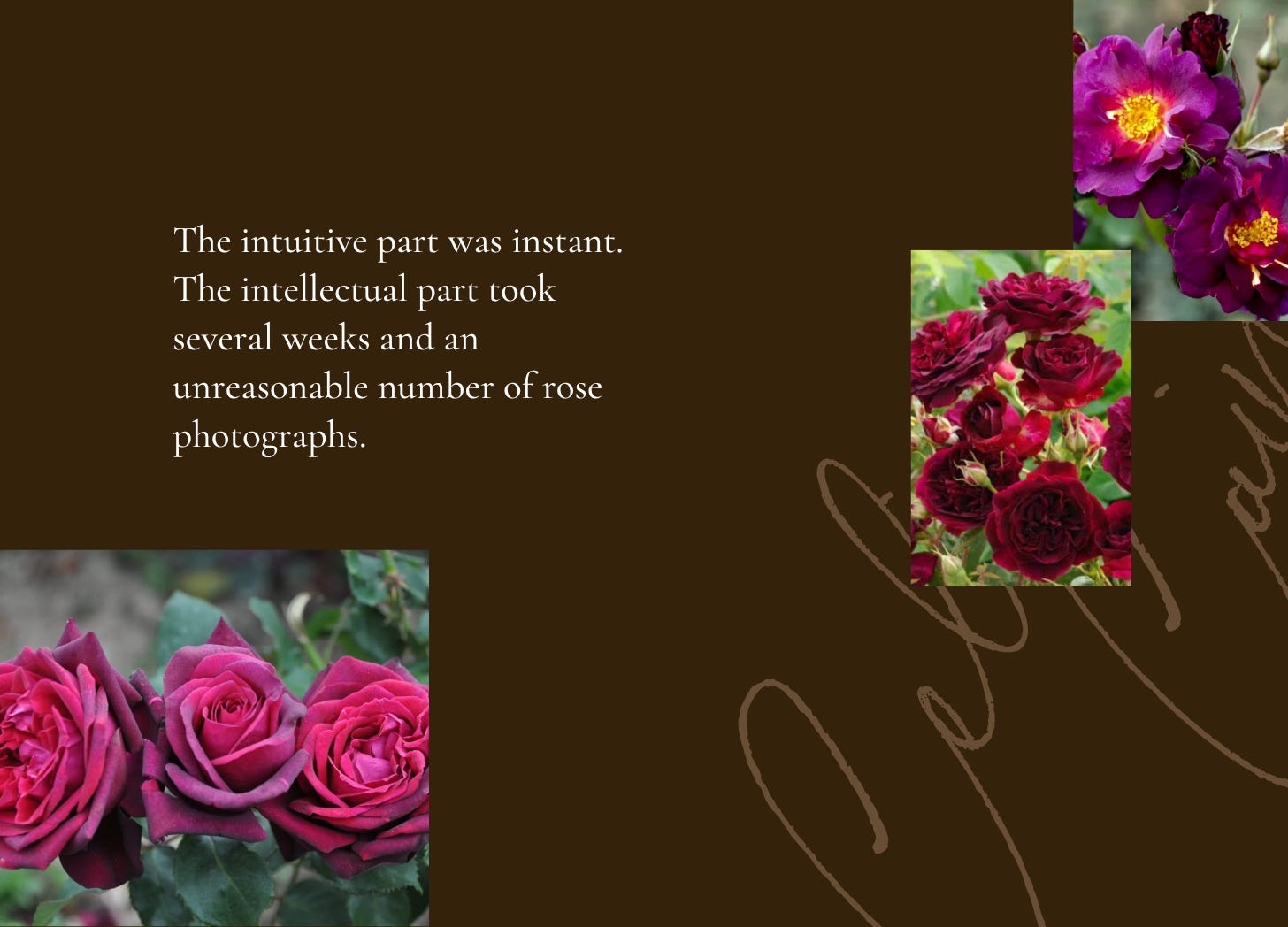
The intuitive part was instant. The intellectual part took several weeks and involved multiple nurseries, gardening forums, a garden designer, and an unreasonable number of photographs of dark plum roses.
I recently spent an absurd amount of time trying to choose the perfect rose for a raised bed I’m redoing beside my extension. I blame the British garden designer Jo Thompson, whose gardens are so beautiful and atmospheric that they make you feel as though you should immediately begin restructuring your entire relationship to color. In her book The Gardener’s Palette,1 she uses the David Austin rose Munstead Wood frequently, this extraordinary velvety dark crimson-to-plum rose that somehow manages to feel both dramatic and restrained at the same time.
Naturally, I wanted it.
Unfortunately, Munstead Wood is not available in Canada, at least not that I could find. I would also have happily bought a rose called Wild Rover, another deep plum variety that Jo featured in Chelsea last year, but that one also proved elusive. We are often a few years behind on these things here.
And so began the research phase.
I asked in local gardening groups. I discussed roses at two separate nurseries. I consulted members of The Gardening Mind by Jo Thompson. I zoomed into photos. I read comments. I compared bloom forms and growth habits and shades of magenta versus burgundy versus oxblood. I spent a surprising amount of time trying to determine whether a particular rose would “read too purple” or “too crimson” in evening light.
I love research, as the PhD after my name probably suggests. And to be fair, one of the pleasures of gardening is precisely this sort of low-stakes rabbit hole. Plants invite a kind of dreamy obsessiveness. You imagine future summers. Future light. Future versions of yourself drinking coffee near a border that has finally come together exactly as you hoped.
But somewhere in the middle of all this, I realized I had drifted away from what I had actually felt drawn toward in the first place.
Early on, while looking through photographs online, I had seen a Kordes rose called Dark Desire and immediately felt that little internal click. Not certainty exactly, but recognition. The sort of feeling that says, “Ah. There you are.”
And then, almost immediately, my intellect arrived with follow-up questions.
There were comments online saying it could sprawl. Maybe it would get too large for the space. Maybe the color would lean too purple in person. Maybe another rose would perform better or be a better size. Maybe there was something I hadn’t considered yet. Since I had never seen any of these roses bloom in real life, the internet became an increasingly elaborate attempt to bridge the distance between information and experience.
In the end, my large local nursery put all their roses on a 30% off flash sale and I went over and bought Dark Desire.
And then the next day, I stopped by my favorite smaller nursery, where the owner immediately said, “Oh, I have a rose I think you’ll love,” and walked me directly over to Dark Desire.
Which honestly made me laugh because that is so often how these things work.
This is one of the things I’ve been thinking about while creating Structured Intuition, my short course on intuition, discernment, and the strange relationship many intellectual people have with intuitive knowing. Not because intellect is bad. I’m an intellectual myself. But many thoughtful people learn early that they can trust analysis more easily than resonance.
Structured Intuition is currently available on presale pricing through May 22.
Not always, of course. Sometimes more information genuinely changes the picture. Sometimes research matters. Sometimes your first impression is incomplete. Intuition is not infallible and intellect is not the enemy. Eventually, I realized I was comparing photographs of roses taken in completely different climates and lighting conditions while trying to determine whether a bloom might be “too magenta.” which was probably a sign that something besides horticultural discernment had entered the chat. All that research didn’t clarify my decision. Instead, it made me aware of every possible thing that could go wrong with it.
I think a lot of intellectual people do this. We keep researching partly because research is pleasurable, uncertainty is unpleasant, and the internet keeps offering the fantasy that one more opinion, one more article, one more comparison photo might finally remove the vulnerability of having to trust yourself.
Unfortunately, this is not how intuition works. Or gardening.
Mini Mindset Tip:
If you notice yourself circling the same decision repeatedly, try pausing before gathering one more opinion, opening one more tab, or rereading the same Reddit thread for the fourteenth time. Settle into your body and ask for your first reaction to return.
More information may genuinely help. Sometimes you really do need more time. But occasionally it becomes clear that what you are searching for is not another opinion, but relief from the vulnerability of having to trust your own perception.
And sometimes it turns out the rose you liked in the first place was, in fact, the right rose.
Amazon Affiliate link, which means if you also decide you suddenly need to rethink your entire relationship to garden color palettes (and you should, it’s a great book), I may earn a small commission. And Canadians! I got this through booksellers.ca (this is also an affiliate link), so you don’t need to buy it from That Place. There are options!
I needed to read this! The research is so enjoyable it easily becomes a tool of procrastination or it muddies your decisions further!